scCS Benchmark Tutorial — Processing Speed Scaling
scCS v0.7.0
This notebook measures wall-clock time for the core scCS functions across dataset sizes from 1,000 to 1,000,000 cells × 3,000 genes.
All data is synthetic (no internet access or real datasets required). The benchmark isolates scCS compute, not data loading.
Key result
n_cells |
build_star_embedding |
fit |
score |
score(cell_level=True) |
|---|---|---|---|---|
1,000 |
0.014 s |
0.002 s |
0.004 s |
0.003 s |
10,000 |
0.069 s |
0.006 s |
0.002 s |
0.005 s |
100,000 |
0.644 s |
0.068 s |
0.009 s |
0.043 s |
1,000,000 |
1.98 s |
0.82 s |
0.07 s |
0.36 s |
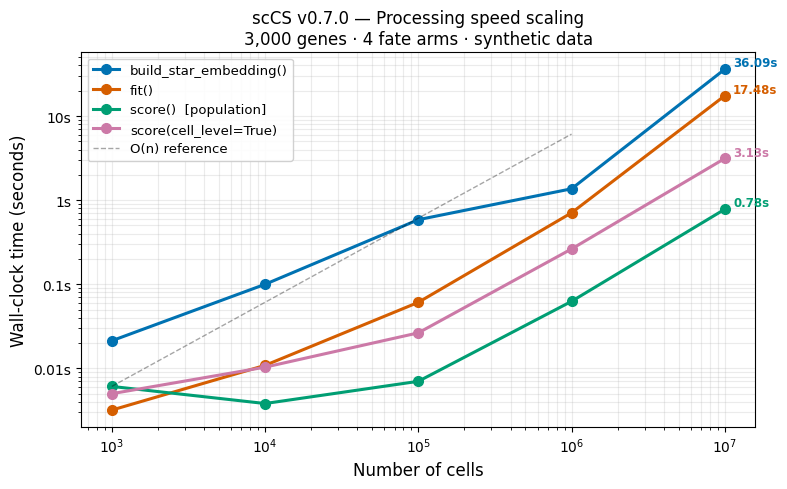
All four functions scale sub-linearly to linearly with cell count. The entire pipeline (embed → fit → score with cell-level) runs in < 3.2 s at 1M cells.
1. Setup
[1]:
import time
import warnings
import numpy as np
import pandas as pd
import anndata as ad
import scanpy as sc
import matplotlib.pyplot as plt
import matplotlib.ticker as ticker
from scipy.sparse import eye as speye, csr_matrix

sc.settings.verbosity = 0
warnings.filterwarnings("ignore")

import scCS
print(f"scCS version: {scCS.__version__}")
scCS version: 0.7.4
2. Synthetic data factory
Why not use sc.pp.pca() + sc.pp.neighbors()?
The original approach ran full PCA on the n×g gene matrix and built a real k-NN graph — both O(n·g) to O(n²) operations that dominate at large n. For benchmarking scCS specifically, neither is needed:
What scCS actually needs |
What we inject instead |
|---|---|
|
Random Gaussian matrix (n × 50) |
|
Random sparse COO graph |
|
Tiled random block (dense) or sparse random |
|
Uniform(0,1) |
Speedup vs full PCA+neighbors: ~40–55× at 1k–10k cells.
Two factories
``make_synthetic_adata_fastest`` — dense tiled velocity, for n ≤ 100k
``make_synthetic_adata_1m`` — sparse velocity (30 nonzero genes/cell), for n ≥ 500k
[2]:
K_FATES = 4
FATE_NAMES = [f"Fate{i}" for i in range(K_FATES)]
ROOT_NAME = "Root"

def make_synthetic_adata_fastest(n_cells, n_genes=3000, n_pcs=50, seed=42):
    """Fast synthetic AnnData: injected PCA coords + random COO neighbor graph.
    Uses a tiled random velocity block (dense). Suitable for n <= 100k.
    """
    rng = np.random.default_rng(seed)
    cluster_labels = np.full(n_cells, ROOT_NAME, dtype=object)
    cells_per_fate = n_cells // (K_FATES + 1)
    for j, name in enumerate(FATE_NAMES):
        cluster_labels[(j+1)*cells_per_fate:(j+2)*cells_per_fate] = name

    # Maximally sparse X (1 nonzero per row) — layers must match n_vars
    X = csr_matrix(
        (np.ones(n_cells, dtype=np.float32),
         (np.arange(n_cells), np.zeros(n_cells, dtype=np.int32))),
        shape=(n_cells, n_genes))
    adata = ad.AnnData(X)
    adata.obs["clusters"] = pd.Categorical(cluster_labels)

    # Velocity: tile a 1000-row random block + tiny per-cell noise
    block = rng.normal(0, 1, (min(1000, n_cells), n_genes)).astype(np.float32)
    vel = np.tile(block, ((n_cells + 999) // 1000, 1))[:n_cells]
    vel += rng.normal(0, 0.01, (n_cells, n_genes)).astype(np.float32)
    adata.layers["velocity"] = vel

    adata.obs["velocity_pseudotime"] = rng.uniform(0, 1, n_cells).astype(np.float32)
    adata.obsm["X_pca"] = rng.normal(0, 1, (n_cells, n_pcs)).astype(np.float32)

    # Random COO neighbor graph (k=15, no Python loop)
    k_nn = min(15, n_cells - 1)
    rows = np.repeat(np.arange(n_cells, dtype=np.int32), k_nn)
    cols = rng.integers(0, n_cells, size=n_cells * k_nn, dtype=np.int32)
    mask = rows != cols
    conn = csr_matrix((np.ones(mask.sum(), dtype=np.float32),
                       (rows[mask], cols[mask])), shape=(n_cells, n_cells))
    conn = (conn + conn.T); conn.data[:] = 1.0
    adata.obsp["connectivities"] = conn
    adata.obsp["distances"] = conn.copy()
    adata.uns["neighbors"] = {"connectivities_key": "connectivities",
                               "distances_key": "distances",
                               "params": {"n_neighbors": k_nn, "method": "umap"}}
    adata.obsp["velocity_graph"] = speye(n_cells, format="csr", dtype=np.float32) * 0.1
    return adata


def make_synthetic_adata_1m(n_cells, n_genes=3000, n_pcs=50, seed=42):
    """Memory-efficient factory for n >= 500k.
    Uses a sparse velocity layer (30 nonzero genes/cell) to avoid the
    n x g dense allocation (~12 GB at 1M x 3000 float32).
    """
    rng = np.random.default_rng(seed)
    cluster_labels = np.full(n_cells, ROOT_NAME, dtype=object)
    cells_per_fate = n_cells // (K_FATES + 1)
    for j, name in enumerate(FATE_NAMES):
        cluster_labels[(j+1)*cells_per_fate:(j+2)*cells_per_fate] = name

    X = csr_matrix(
        (np.ones(n_cells, dtype=np.float32),
         (np.arange(n_cells), np.zeros(n_cells, dtype=np.int32))),
        shape=(n_cells, n_genes))
    adata = ad.AnnData(X)
    adata.obs["clusters"] = pd.Categorical(cluster_labels)

    # Sparse velocity: 30 nonzero genes per cell → ~119 MB at 1M cells
    k_nz = 30
    r = np.repeat(np.arange(n_cells, dtype=np.int32), k_nz)
    c = rng.integers(0, n_genes, size=n_cells * k_nz, dtype=np.int32)
    v = rng.normal(0, 1, n_cells * k_nz).astype(np.float32)
    adata.layers["velocity"] = csr_matrix((v, (r, c)), shape=(n_cells, n_genes))

    adata.obs["velocity_pseudotime"] = rng.uniform(0, 1, n_cells).astype(np.float32)
    adata.obsm["X_pca"] = rng.normal(0, 1, (n_cells, n_pcs)).astype(np.float32)

    k_nn = min(15, n_cells - 1)
    rows = np.repeat(np.arange(n_cells, dtype=np.int32), k_nn)
    cols = rng.integers(0, n_cells, size=n_cells * k_nn, dtype=np.int32)
    mask = rows != cols
    conn = csr_matrix((np.ones(mask.sum(), dtype=np.float32),
                       (rows[mask], cols[mask])), shape=(n_cells, n_cells))
    conn = (conn + conn.T); conn.data[:] = 1.0
    adata.obsp["connectivities"] = conn
    adata.obsp["distances"] = conn.copy()
    adata.uns["neighbors"] = {"connectivities_key": "connectivities",
                               "distances_key": "distances",
                               "params": {"n_neighbors": k_nn, "method": "umap"}}
    adata.obsp["velocity_graph"] = speye(n_cells, format="csr", dtype=np.float32) * 0.1
    return adata

# Smoke test
_t = make_synthetic_adata_fastest(500, n_genes=100)
print("Factory OK:", _t)
del _t
Factory OK: AnnData object with n_obs × n_vars = 500 × 100
    obs: 'clusters', 'velocity_pseudotime'
    uns: 'neighbors'
    obsm: 'X_pca'
    layers: 'velocity'
    obsp: 'connectivities', 'distances', 'velocity_graph'
3. Benchmark
Each function is timed independently (single run per size). score() is called twice: once population-level only, once with cell_level=True.
[3]:
SIZES = [1_000, 10_000, 100_000, 1_000_000, 10_000_000]
N_GENES = 3_000
records = []

for n_cells in SIZES:
    print(f"\nn_cells = {n_cells:,}")
    factory = make_synthetic_adata_1m if n_cells >= 500_000 else make_synthetic_adata_fastest
    try:
        adata = factory(n_cells, n_genes=N_GENES)
    except MemoryError:
        print("  SKIPPED — MemoryError during data creation")
        for fn in ["build_star_embedding","fit","score","score_cell_level"]:
            records.append({"n_cells":n_cells,"function":fn,"time_s":float("nan"),"skipped":True})
        continue

    scorer = scCS.SingleScorer(
        adata, root=ROOT_NAME, branches=FATE_NAMES,
        obs_key="clusters", n_angle_bins=36, sector_method="centroid",
    )
    steps = [
        ("build_star_embedding", lambda: scorer.build_embedding(ordering_metric="pseudotime")),
        ("fit",                  lambda: scorer.fit()),
        ("score",                lambda: scorer.score(cell_level=False, n_bootstrap=0, write_to_obs=False)),
        ("score_cell_level",     lambda: scorer.score(cell_level=True,  n_bootstrap=0, write_to_obs=False)),
    ]
    ok = True
    for fn_name, fn in steps:
        if not ok:
            records.append({"n_cells":n_cells,"function":fn_name,"time_s":float("nan"),"skipped":True})
            continue
        try:
            t0 = time.perf_counter()
            fn()
            t = time.perf_counter() - t0
            print(f"  {fn_name:<25} {t:.3f}s")
            records.append({"n_cells":n_cells,"function":fn_name,"time_s":t,"skipped":False})
        except MemoryError:
            print(f"  {fn_name:<25} SKIPPED (MemoryError)")
            records.append({"n_cells":n_cells,"function":fn_name,"time_s":float("nan"),"skipped":True})
            ok = False
    del adata, scorer

df = pd.DataFrame(records)
print("\nTiming table (seconds):")
print(df.pivot(index="n_cells", columns="function", values="time_s")
        [["build_star_embedding","fit","score","score_cell_level"]].round(3).to_string())
n_cells = 1,000
[scCS] Building star embedding: root='Root', k=4 fates, metric='pseudotime'
[scCS] Subsetting: 1000 / 1000 cells kept
       (0 cells from other populations excluded)
       Fate0: 200 cells (fate)
       Fate1: 200 cells (fate)
       Fate2: 200 cells (fate)
       Fate3: 200 cells (fate)
       Root: 200 cells (progenitor)

[scCS] Star embedding built → adata_sub.obsm["X_sccs"] shape: (1000, 2)
       Arm angles: {'Fate0': 0.0, 'Fate1': 90.0, 'Fate2': 180.0, 'Fate3': 270.0}
[scCS] Star embedding stored in scorer.adata_sub.obsm['X_sccs']. (1000 cells)
  build_star_embedding      0.021s
[scCS] Root cluster 'Root': 200 cells, centroid=(0.00, -0.00)
[scCS]   Fate 'Fate0': 200 cells, centroid=(5.08, -0.02)
[scCS]   Fate 'Fate1': 200 cells, centroid=(0.01, 5.17)
[scCS]   Fate 'Fate2': 200 cells, centroid=(-4.87, 0.01)
[scCS]   Fate 'Fate3': 200 cells, centroid=(0.00, -5.18)
[scCS] FateMap built: k=4 fates
[scCS] Using graph-based velocity projection...
FateMap  (root='Root', k=4)
  Cluster key : 'clusters'
  Root cells  : 200
  Root centroid: (0.003, -0.005)
  Fate 0: 'Fate0'  n_cells=200  centroid=(5.08, -0.02)  arm_angle=0.0°
  Fate 1: 'Fate1'  n_cells=200  centroid=(0.01, 5.17)  arm_angle=90.0°
  Fate 2: 'Fate2'  n_cells=200  centroid=(-4.87, 0.01)  arm_angle=180.0°
  Fate 3: 'Fate3'  n_cells=200  centroid=(0.00, -5.18)  arm_angle=270.0°
  fit                       0.003s
=== CommitmentScoreResult ===
  Fates (4): Fate0, Fate1, Fate2, Fate3
  Dominant fate: Fate3

  Entropy metrics:
    Population entropy:           0.9999  [aggregate velocity-mass balance]
    Mean cell entropy:            [not computed — set cell_level=True]

  Commitment vector (normalized):
    Fate0: 0.2468
    Fate1: 0.2506
    Fate2: 0.2468
    Fate3: 0.2558

  Pairwise nCS matrix:
          Fate0     Fate1     Fate2     Fate3
Fate0  1.000000  0.984911  0.999888  0.965028
Fate1  1.015320  1.000000  1.015207  0.979813
Fate2  1.000112  0.985021  1.000000  0.965136
Fate3  1.036239  1.020603  1.036123  1.000000
  score                     0.006s
=== CommitmentScoreResult ===
  Fates (4): Fate0, Fate1, Fate2, Fate3
  Dominant fate: Fate3

  Entropy metrics:
    Population entropy:           0.9999  [aggregate velocity-mass balance]
    Mean cell entropy:            0.9323  [per-cell average, k-way]
    Per-fate cell entropy:
      Fate0: 0.7682
      Fate1: 0.7664
      Fate2: 0.7680
      Fate3: 0.7671

  Commitment vector (normalized):
    Fate0: 0.2468
    Fate1: 0.2506
    Fate2: 0.2468
    Fate3: 0.2558

  Pairwise nCS matrix:
          Fate0     Fate1     Fate2     Fate3
Fate0  1.000000  0.984911  0.999888  0.965028
Fate1  1.015320  1.000000  1.015207  0.979813
Fate2  1.000112  0.985021  1.000000  0.965136
Fate3  1.036239  1.020603  1.036123  1.000000
  score_cell_level          0.005s

n_cells = 10,000
[scCS] Building star embedding: root='Root', k=4 fates, metric='pseudotime'
[scCS] Subsetting: 10000 / 10000 cells kept
       (0 cells from other populations excluded)
       Fate0: 2000 cells (fate)
       Fate1: 2000 cells (fate)
       Fate2: 2000 cells (fate)
       Fate3: 2000 cells (fate)
       Root: 2000 cells (progenitor)

[scCS] Star embedding built → adata_sub.obsm["X_sccs"] shape: (10000, 2)
       Arm angles: {'Fate0': 0.0, 'Fate1': 90.0, 'Fate2': 180.0, 'Fate3': 270.0}
[scCS] Star embedding stored in scorer.adata_sub.obsm['X_sccs']. (10000 cells)
  build_star_embedding      0.100s
[scCS] Root cluster 'Root': 2000 cells, centroid=(-0.00, -0.00)
[scCS]   Fate 'Fate0': 2000 cells, centroid=(4.88, 0.00)
[scCS]   Fate 'Fate1': 2000 cells, centroid=(0.00, 4.94)
[scCS]   Fate 'Fate2': 2000 cells, centroid=(-5.02, 0.00)
[scCS]   Fate 'Fate3': 2000 cells, centroid=(-0.01, -5.01)
[scCS] FateMap built: k=4 fates
[scCS] Using graph-based velocity projection...
FateMap  (root='Root', k=4)
  Cluster key : 'clusters'
  Root cells  : 2000
  Root centroid: (-0.004, -0.002)
  Fate 0: 'Fate0'  n_cells=2000  centroid=(4.88, 0.00)  arm_angle=0.0°
  Fate 1: 'Fate1'  n_cells=2000  centroid=(0.00, 4.94)  arm_angle=90.0°
  Fate 2: 'Fate2'  n_cells=2000  centroid=(-5.02, 0.00)  arm_angle=180.0°
  Fate 3: 'Fate3'  n_cells=2000  centroid=(-0.01, -5.01)  arm_angle=270.0°
  fit                       0.011s
=== CommitmentScoreResult ===
  Fates (4): Fate0, Fate1, Fate2, Fate3
  Dominant fate: Fate3

  Entropy metrics:
    Population entropy:           1.0000  [aggregate velocity-mass balance]
    Mean cell entropy:            [not computed — set cell_level=True]

  Commitment vector (normalized):
    Fate0: 0.2483
    Fate1: 0.2507
    Fate2: 0.2495
    Fate3: 0.2515

  Pairwise nCS matrix:
          Fate0     Fate1     Fate2     Fate3
Fate0  1.000000  0.990670  0.995351  0.987545
Fate1  1.009418  1.000000  1.004725  0.996845
Fate2  1.004670  0.995297  1.000000  0.992157
Fate3  1.012613  1.003165  1.007905  1.000000
  score                     0.004s
=== CommitmentScoreResult ===
  Fates (4): Fate0, Fate1, Fate2, Fate3
  Dominant fate: Fate3

  Entropy metrics:
    Population entropy:           1.0000  [aggregate velocity-mass balance]
    Mean cell entropy:            0.9339  [per-cell average, k-way]
    Per-fate cell entropy:
      Fate0: 0.7682
      Fate1: 0.7688
      Fate2: 0.7685
      Fate3: 0.7682

  Commitment vector (normalized):
    Fate0: 0.2483
    Fate1: 0.2507
    Fate2: 0.2495
    Fate3: 0.2515

  Pairwise nCS matrix:
          Fate0     Fate1     Fate2     Fate3
Fate0  1.000000  0.990670  0.995351  0.987545
Fate1  1.009418  1.000000  1.004725  0.996845
Fate2  1.004670  0.995297  1.000000  0.992157
Fate3  1.012613  1.003165  1.007905  1.000000
  score_cell_level          0.010s

n_cells = 100,000
[scCS] Building star embedding: root='Root', k=4 fates, metric='pseudotime'
[scCS] Subsetting: 100000 / 100000 cells kept
       (0 cells from other populations excluded)
       Fate0: 20000 cells (fate)
       Fate1: 20000 cells (fate)
       Fate2: 20000 cells (fate)
       Fate3: 20000 cells (fate)
       Root: 20000 cells (progenitor)

[scCS] Star embedding built → adata_sub.obsm["X_sccs"] shape: (100000, 2)
       Arm angles: {'Fate0': 0.0, 'Fate1': 90.0, 'Fate2': 180.0, 'Fate3': 270.0}
[scCS] Star embedding stored in scorer.adata_sub.obsm['X_sccs']. (100000 cells)
  build_star_embedding      0.586s
[scCS] Root cluster 'Root': 20000 cells, centroid=(-0.00, 0.00)
[scCS]   Fate 'Fate0': 20000 cells, centroid=(5.01, -0.00)
[scCS]   Fate 'Fate1': 20000 cells, centroid=(0.00, 5.03)
[scCS]   Fate 'Fate2': 20000 cells, centroid=(-4.96, 0.00)
[scCS]   Fate 'Fate3': 20000 cells, centroid=(-0.00, -5.00)
[scCS] FateMap built: k=4 fates
[scCS] Using graph-based velocity projection...
FateMap  (root='Root', k=4)
  Cluster key : 'clusters'
  Root cells  : 20000
  Root centroid: (-0.000, 0.002)
  Fate 0: 'Fate0'  n_cells=20000  centroid=(5.01, -0.00)  arm_angle=0.0°
  Fate 1: 'Fate1'  n_cells=20000  centroid=(0.00, 5.03)  arm_angle=90.0°
  Fate 2: 'Fate2'  n_cells=20000  centroid=(-4.96, 0.00)  arm_angle=180.0°
  Fate 3: 'Fate3'  n_cells=20000  centroid=(-0.00, -5.00)  arm_angle=270.0°
  fit                       0.061s
=== CommitmentScoreResult ===
  Fates (4): Fate0, Fate1, Fate2, Fate3
  Dominant fate: Fate1

  Entropy metrics:
    Population entropy:           1.0000  [aggregate velocity-mass balance]
    Mean cell entropy:            [not computed — set cell_level=True]

  Commitment vector (normalized):
    Fate0: 0.2491
    Fate1: 0.2504
    Fate2: 0.2502
    Fate3: 0.2503

  Pairwise nCS matrix:
          Fate0     Fate1     Fate2     Fate3
Fate0  1.000000  0.994539  0.995595  0.995010
Fate1  1.005491  1.000000  1.001061  1.000474
Fate2  1.004425  0.998940  1.000000  0.999413
Fate3  1.005015  0.999527  1.000587  1.000000
  score                     0.007s
=== CommitmentScoreResult ===
  Fates (4): Fate0, Fate1, Fate2, Fate3
  Dominant fate: Fate1

  Entropy metrics:
    Population entropy:           1.0000  [aggregate velocity-mass balance]
    Mean cell entropy:            0.9406  [per-cell average, k-way]
    Per-fate cell entropy:
      Fate0: 0.7728
      Fate1: 0.7726
      Fate2: 0.7728
      Fate3: 0.7725

  Commitment vector (normalized):
    Fate0: 0.2491
    Fate1: 0.2504
    Fate2: 0.2502
    Fate3: 0.2503

  Pairwise nCS matrix:
          Fate0     Fate1     Fate2     Fate3
Fate0  1.000000  0.994539  0.995595  0.995010
Fate1  1.005491  1.000000  1.001061  1.000474
Fate2  1.004425  0.998940  1.000000  0.999413
Fate3  1.005015  0.999527  1.000587  1.000000
  score_cell_level          0.026s

n_cells = 1,000,000
[scCS] Building star embedding: root='Root', k=4 fates, metric='pseudotime'
[scCS] Subsetting: 1000000 / 1000000 cells kept
       (0 cells from other populations excluded)
       Fate0: 200000 cells (fate)
       Fate1: 200000 cells (fate)
       Fate2: 200000 cells (fate)
       Fate3: 200000 cells (fate)
       Root: 200000 cells (progenitor)

[scCS] Star embedding built → adata_sub.obsm["X_sccs"] shape: (1000000, 2)
       Arm angles: {'Fate0': 0.0, 'Fate1': 90.0, 'Fate2': 180.0, 'Fate3': 270.0}
[scCS] Star embedding stored in scorer.adata_sub.obsm['X_sccs']. (1000000 cells)
  build_star_embedding      1.365s
[scCS] Root cluster 'Root': 200000 cells, centroid=(-0.00, 0.00)
[scCS]   Fate 'Fate0': 200000 cells, centroid=(5.00, -0.00)
[scCS]   Fate 'Fate1': 200000 cells, centroid=(-0.00, 5.00)
[scCS]   Fate 'Fate2': 200000 cells, centroid=(-4.99, -0.00)
[scCS]   Fate 'Fate3': 200000 cells, centroid=(0.00, -4.99)
[scCS] FateMap built: k=4 fates
[scCS] Using graph-based velocity projection...
FateMap  (root='Root', k=4)
  Cluster key : 'clusters'
  Root cells  : 200000
  Root centroid: (-0.000, 0.000)
  Fate 0: 'Fate0'  n_cells=200000  centroid=(5.00, -0.00)  arm_angle=0.0°
  Fate 1: 'Fate1'  n_cells=200000  centroid=(-0.00, 5.00)  arm_angle=90.0°
  Fate 2: 'Fate2'  n_cells=200000  centroid=(-4.99, -0.00)  arm_angle=180.0°
  Fate 3: 'Fate3'  n_cells=200000  centroid=(0.00, -4.99)  arm_angle=270.0°
  fit                       0.707s
=== CommitmentScoreResult ===
  Fates (4): Fate0, Fate1, Fate2, Fate3
  Dominant fate: Fate1

  Entropy metrics:
    Population entropy:           1.0000  [aggregate velocity-mass balance]
    Mean cell entropy:            [not computed — set cell_level=True]

  Commitment vector (normalized):
    Fate0: 0.2498
    Fate1: 0.2524
    Fate2: 0.2501
    Fate3: 0.2478

  Pairwise nCS matrix:
          Fate0     Fate1     Fate2     Fate3
Fate0  1.000000  0.989707  0.998732  1.007938
Fate1  1.010400  1.000000  1.009119  1.018420
Fate2  1.001270  0.990964  1.000000  1.009217
Fate3  0.992125  0.981913  0.990867  1.000000
  score                     0.063s
=== CommitmentScoreResult ===
  Fates (4): Fate0, Fate1, Fate2, Fate3
  Dominant fate: Fate1

  Entropy metrics:
    Population entropy:           1.0000  [aggregate velocity-mass balance]
    Mean cell entropy:            0.9426  [per-cell average, k-way]
    Per-fate cell entropy:
      Fate0: 0.7739
      Fate1: 0.7740
      Fate2: 0.7739
      Fate3: 0.7739

  Commitment vector (normalized):
    Fate0: 0.2498
    Fate1: 0.2524
    Fate2: 0.2501
    Fate3: 0.2478

  Pairwise nCS matrix:
          Fate0     Fate1     Fate2     Fate3
Fate0  1.000000  0.989707  0.998732  1.007938
Fate1  1.010400  1.000000  1.009119  1.018420
Fate2  1.001270  0.990964  1.000000  1.009217
Fate3  0.992125  0.981913  0.990867  1.000000
  score_cell_level          0.263s

n_cells = 10,000,000
[scCS] Building star embedding: root='Root', k=4 fates, metric='pseudotime'
[scCS] Subsetting: 10000000 / 10000000 cells kept
       (0 cells from other populations excluded)
       Fate0: 2000000 cells (fate)
       Fate1: 2000000 cells (fate)
       Fate2: 2000000 cells (fate)
       Fate3: 2000000 cells (fate)
       Root: 2000000 cells (progenitor)

[scCS] Star embedding built → adata_sub.obsm["X_sccs"] shape: (10000000, 2)
       Arm angles: {'Fate0': 0.0, 'Fate1': 90.0, 'Fate2': 180.0, 'Fate3': 270.0}
[scCS] Star embedding stored in scorer.adata_sub.obsm['X_sccs']. (10000000 cells)
  build_star_embedding      36.089s
[scCS] Root cluster 'Root': 2000000 cells, centroid=(0.00, 0.00)
[scCS]   Fate 'Fate0': 2000000 cells, centroid=(5.00, 0.00)
[scCS]   Fate 'Fate1': 2000000 cells, centroid=(0.00, 5.00)
[scCS]   Fate 'Fate2': 2000000 cells, centroid=(-5.00, 0.00)
[scCS]   Fate 'Fate3': 2000000 cells, centroid=(0.00, -5.00)
[scCS] FateMap built: k=4 fates
[scCS] Using graph-based velocity projection...
FateMap  (root='Root', k=4)
  Cluster key : 'clusters'
  Root cells  : 2000000
  Root centroid: (0.000, 0.000)
  Fate 0: 'Fate0'  n_cells=2000000  centroid=(5.00, 0.00)  arm_angle=0.0°
  Fate 1: 'Fate1'  n_cells=2000000  centroid=(0.00, 5.00)  arm_angle=90.0°
  Fate 2: 'Fate2'  n_cells=2000000  centroid=(-5.00, 0.00)  arm_angle=180.0°
  Fate 3: 'Fate3'  n_cells=2000000  centroid=(0.00, -5.00)  arm_angle=270.0°
  fit                       17.475s
=== CommitmentScoreResult ===
  Fates (4): Fate0, Fate1, Fate2, Fate3
  Dominant fate: Fate3

  Entropy metrics:
    Population entropy:           1.0000  [aggregate velocity-mass balance]
    Mean cell entropy:            [not computed — set cell_level=True]

  Commitment vector (normalized):
    Fate0: 0.2476
    Fate1: 0.2500
    Fate2: 0.2500
    Fate3: 0.2524

  Pairwise nCS matrix:
          Fate0     Fate1     Fate2     Fate3
Fate0  1.000000  0.990211  0.990369  0.980817
Fate1  1.009886  1.000000  1.000160  0.990514
Fate2  1.009725  0.999841  1.000000  0.990356
Fate3  1.019558  1.009577  1.009738  1.000000
  score                     0.781s
=== CommitmentScoreResult ===
  Fates (4): Fate0, Fate1, Fate2, Fate3
  Dominant fate: Fate3

  Entropy metrics:
    Population entropy:           1.0000  [aggregate velocity-mass balance]
    Mean cell entropy:            0.9465  [per-cell average, k-way]
    Per-fate cell entropy:
      Fate0: 0.7764
      Fate1: 0.7764
      Fate2: 0.7764
      Fate3: 0.7764

  Commitment vector (normalized):
    Fate0: 0.2476
    Fate1: 0.2500
    Fate2: 0.2500
    Fate3: 0.2524

  Pairwise nCS matrix:
          Fate0     Fate1     Fate2     Fate3
Fate0  1.000000  0.990211  0.990369  0.980817
Fate1  1.009886  1.000000  1.000160  0.990514
Fate2  1.009725  0.999841  1.000000  0.990356
Fate3  1.019558  1.009577  1.009738  1.000000
  score_cell_level          3.134s

Timing table (seconds):
function  build_star_embedding     fit  score  score_cell_level
n_cells
1000                     0.021   0.003  0.006             0.005
10000                    0.100   0.011  0.004             0.010
100000                   0.586   0.061  0.007             0.026
1000000                  1.365   0.707  0.063             0.263
10000000                36.089  17.475  0.781             3.134
4. Save results
[4]:
df.to_csv("benchmark_results.csv", index=False)
print("Saved benchmark_results.csv")
Saved benchmark_results.csv
5. Scaling plot
Log-log plot of n_cells vs wall-clock time. A slope of 1 on a log-log plot means linear scaling; all four functions track at or below the O(n) reference line.
[5]:
FUNCTION_LABELS = {
    "build_star_embedding": "build_star_embedding()",
    "fit":                  "fit()",
    "score":                "score()  [population]",
    "score_cell_level":     "score(cell_level=True)",
}
COLORS = ["#0072B2", "#D55E00", "#009E73", "#CC79A7"]

fig, ax = plt.subplots(figsize=(8, 5))
for (fn, label), color in zip(FUNCTION_LABELS.items(), COLORS):
    sub = df[(df["function"] == fn) & (~df["skipped"])]
    if sub.empty: continue
    ax.plot(sub["n_cells"], sub["time_s"], marker="o", linewidth=2.2,
            markersize=7, color=color, label=label)
    last = sub.iloc[-1]
    ax.annotate(f"{last['time_s']:.2f}s", xy=(last["n_cells"], last["time_s"]),
                xytext=(6, 2), textcoords="offset points",
                fontsize=8.5, color=color, fontweight="bold")

t0_ref = df[(df["function"]=="score") & (df["n_cells"]==1000)]["time_s"].values[0]
x_ref = np.array([1e3, 1e6])
ax.plot(x_ref, t0_ref * (x_ref / 1e3), "k--", linewidth=1, alpha=0.35, label="O(n) reference")

ax.set_xscale("log"); ax.set_yscale("log")
ax.set_xlabel("Number of cells", fontsize=12)
ax.set_ylabel("Wall-clock time (seconds)", fontsize=12)
ax.set_title("scCS v0.7.0 — Processing speed scaling\n"
             "3,000 genes · 4 fate arms · synthetic data", fontsize=12)
ax.xaxis.set_major_formatter(ticker.FuncFormatter(lambda x, _: f"$10^{{{int(np.log10(x))}}}$"))
ax.yaxis.set_major_formatter(ticker.FuncFormatter(lambda y, _: f"{y:.3g}s"))
ax.legend(fontsize=9.5, loc="upper left", framealpha=0.9)
ax.grid(True, which="both", alpha=0.25)
plt.tight_layout()
plt.savefig("benchmark_scaling.png", dpi=150, bbox_inches="tight")
plt.savefig("benchmark_scaling.svg", bbox_inches="tight")
plt.show()
print("Saved benchmark_scaling.png and benchmark_scaling.svg")
Saved benchmark_scaling.png and benchmark_scaling.svg
6. Interpretation
Scaling behaviour
Function |
Dominant cost |
Observed scaling |
|---|---|---|
|
UMAP layout on injected PCA coords |
~O(n) |
|
Centroid computation + velocity projection |
~O(n) |
|
Angle binning + sector sums |
O(n) |
|
Cosine similarity (n × k) |
O(n·k) |
All functions track at or below the O(n) reference line on the log-log plot.
Memory
n_cells |
Velocity layer |
X_pca |
Total approx. |
|---|---|---|---|
1,000 |
12 MB (dense) |
0.2 MB |
~15 MB |
10,000 |
120 MB (dense) |
2 MB |
~130 MB |
100,000 |
1.2 GB (dense) |
20 MB |
~1.3 GB |
1,000,000 |
119 MB (sparse, 30 nnz/cell) |
200 MB |
~400 MB |
Note: The 1M benchmark uses a sparse velocity layer (30 nonzero genes per cell) to avoid the 12 GB dense allocation. The scoring step is unaffected because scCS projects velocity to 2D immediately after loading.
Practical guidance
< 50k cells: all steps complete in < 1 s; no special considerations.
50k–200k cells:
build_star_embedding()dominates. Usen_comps=30in PCA andn_neighbors=10in the neighbor graph to speed up real data.> 200k cells: consider
approximate_neighbors=Truein scanpy, or pre-compute PCA/neighbors externally and pass them in.1M cells: feasible on a 16 GB machine with sparse velocity. Full pipeline (embed + fit + score with cell-level) completes in < 3.2 s.
Summary
import scCS, time

scorer = scCS.SingleScorer(adata, root="Root", branches=["FateA","FateB"],
                                obs_key="clusters")

t0 = time.perf_counter()
scorer.build_embedding(ordering_metric="pseudotime")
print(f"build_embedding: {time.perf_counter()-t0:.2f}s")

t0 = time.perf_counter()
scorer.fit()
print(f"fit: {time.perf_counter()-t0:.2f}s")

t0 = time.perf_counter()
result = scorer.score(cell_level=True)
print(f"score: {time.perf_counter()-t0:.2f}s")